

Industry Trends: A Pivotal Moment for Wood Processing Infrastructure
RFS continues to monitor trends in timberland management, conservation and nature-based finance, and wood processing infrastructure investment strategies to assess potential opportunities for increasing regional infrastructure development capacity in California.
The recent acquisition of South Coast Lumber by Chinook Forest Partners in Oregon, signals a growing convergence between timberland portfolio managers, conservation, and wood utilization infrastructure—an integrated investment strategy that could strengthen forest stewardship outcomes and support regional forest stewardship economies. However, this type of progressive investment strategy has yet to occur in California presumably due to the high cost of doing business in-state, low specification demand, and low-margins of producing commodity lumber products at scale. The recent closure of the Roseburg Veneer facility in Weed, California, underscores the fragility of the state’s wood processing capacity. California now has just 29 operating facilities, down from over 180 in the 1980’s. We remain hopeful that a pathway forward can be found to preserve Roseburg as a regional asset along with the ~150 skilled people that worked there.
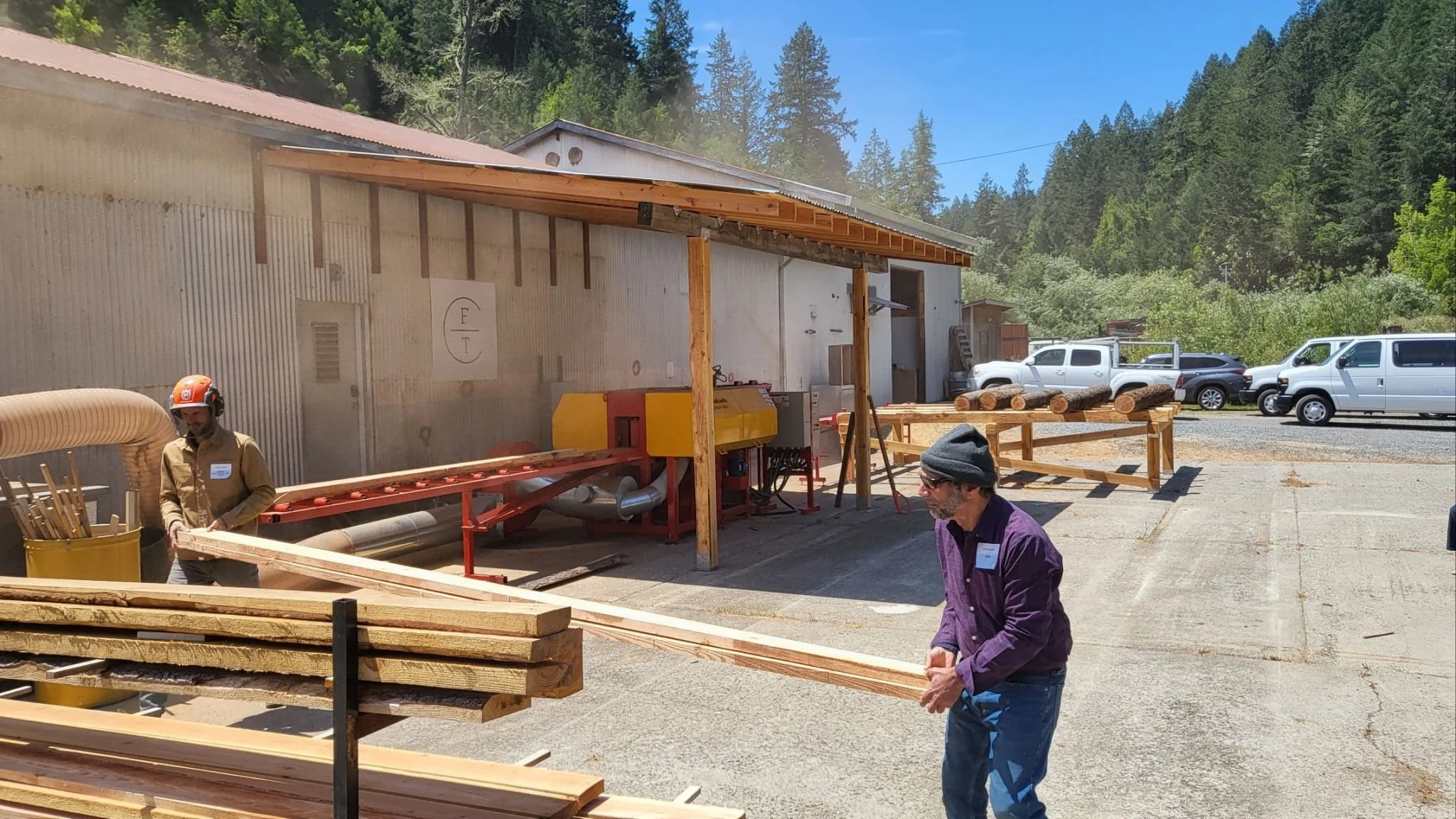
Forestree Collective’s small-scale wood utilization campus in Sonoma County. Pictured above, founder Jeremy Fisher and local forester, Fred Euphrat, remove small-diameter Douglas fir lumber from the mill and stack it for drying.
Despite the general decline in wood processing infrastructure, these gaps represent significant opportunities. California’s large market, progressive environmental policies, and ambitious climate goals are creating strong incentives to develop new wood processing and manufacturing facilities—particularly in regions where infrastructure historically existed or where conditions support long-term viability. Several wood campuses and manufacturing facilities are now in development or under construction across the state, including Timbershed, Klamath River Forest Products, Mosaic Timber, FABRIC Workshop, and Alpenglow Timber. These projects build on recent investments in facilities such as Tahoe Forest Products (just over the state line in Nevada), Hat Creek Lumber, and Tuolumne Biomass, signaling renewed momentum in rebuilding wood processing capacity. At the same time, near-term market conditions present real challenges for financing these capital intensive projects.
Softwood lumber markets have experienced significant volatility of late, and higher interest rates, inflationary pressures, and broader economic uncertainty have constrained private and public investment in new and existing infrastructure. These conditions have made capital more expensive and increased perceived risk, slowing the pace of facility development despite clear demand. California’s urgent need for forest restoration, growing market for climate-smart building materials, and improving legislative support for in-state wood utilization will continue to send strong signals that incentivize infrastructure development while the market recovers. During this time, strategic public investment (such as USDA’s TPEP program), patient, philanthropic capital, and targeted support from individuals will be critical to ensuring that the infrastructure needed to support forest health and economic resilience can emerge and that it endures. RFS is committed to advancing practical, collaborative solutions that bridge this gap and help build a more resilient forest stewardship economy, starting with Timbershed in Sonoma County.
The pathway forward is clear: forest restoration requires processing capacity. Without sustained investment in wood utilization infrastructure, California’s climate and wildfire resilience goals will remain out of reach.